Showing posts with label drawing. Show all posts

Friday, July 1, 2016

One year of sketchnoting

I made my first sketchnote at Write/Speak/Code 2015 on the impostor syndrome talk by Neha Batra.

I started with a single black pen, added a gray marker as I experimented with shading.

My friend saw the little gray hearts and suggested that I get the primary colors, which was perfect since I was about to attend Google I/O.

The overwhelmingly positive reaction I got for my sketchnotes gave me the confidence to try drawing as well, which, mind you, I grew up believing that I cannot draw. It was a pleasant surprise to discover the joy of copying and coloring.

When I first wrote about sketchnoting, I said there is no way I can draw portraits. Guess what, I do that now!

At Write/Speak/Code 2016 I sketchnoted for Neha again, and it is really fun to see how much I have progressed in a year.

You can do it too

I have seen many other engineers start sketchnoting since I posted my first sketchnote last year, and it was been absolutely delightful. Wanna get started? Here are some resources:

Thursday, December 24, 2015

My 2015

End of year offers a great opportunity to take stock at what I have done. Here are my highlights.

Public Speaking

This year I have shifted my efforts from giving talks to enabling others to do so.

  • I started the Technically Speaking newsletter (please subscribe!) last year with Cate Huston, and we continue to publish one issue per week.
  • I ran a grassroot campaign to get more women to speak at Droidcon NYC, resulting in 22% female speakers. I hope this will serve as a blueprint for others, especially conference organizers, to push the limits.
  • In September I gave my very first keynote speech, sharing my tips to blog and speak more. Please watch it and let me know if it helps you get started and level up on your blogging and speaking!

Android Dialogs

I started a YouTube channel with Huyen Tue Dao to interview people in the Android community. It has been really fun picking up video production, and we have been adding more visuals to aid explanations.

Sketchnotes

This came as a total surprise, as I have always considered myself as someone who cannot draw. Turns out sketchnoting is more about constraint satisfaction than drawing. And as an engineer, I am extremely good at that.

I really enjoyed sharing my learnings from conferences this way. I have scanned all my sketchnotes from 2015 into a PDF collection:


gum.co/Sketchnotes2015

It is free to download, but you can also chip in a few dollars if you'd like to support my work.

Courses

I published two classes with Pluralsight this year:

I also drafted a outline for my Espresso book, and wrote a course from it:


gum.co/AndroidTestSharedPref

2016

A few of these projects were surprises. I never thought I'd be producing one video a week, or be known for taking graphic notes! I have no idea what 2016 will bring, but I am looking forward to it!

Saturday, October 3, 2015

How to make hand-drawn slides

I have been doodling quite a bit for my sketchnotes, and I wanted to use them to illustrate my Android Summit keynote.

Pencil-and-paper draft

When I organized my thoughts for the talk, I cut paper into small pieces and draw one picture on each. These are the draft illustrations.

Some of them I was not sure how to draw, so I searched on the web for outline images of the concept, and copied it.

Copy pictures from the web

When I first started sketchnoting, I was really hung up on the idea that I was doing art, and copying is a big no no. But I copy code from StackOverflow all the time, and had no problem with that whatsoever. So I started copying drawings, and found that it always comes out as my own style (due to the lack of artistic skills to make precise copies), so I don't feel bad at all about copying.


Elephant I tried to copy

My elephant

I pick images that have simple outlines, and not too many curves. I found it difficult to copy curves, and if the drawing depends on the curvature to convey the idea, my copy will look horrendous. So I just avoid those.

Redraw on tablet

Once I was happy with the draft slide deck, I redrew the slides on my tablet.

I did not have time to investigate which software I want to use, so I just did a search on a drawing app on Android that supports layers. I ended up using MediBang Paint.

I wanted layers because I reuse some components of my drawing. For instance, I have a book icon to describe experts as people who wrote books, and then later I have a "Rant Book" where I jot down talk ideas.

It was much harder to draw on the tablet than on paper. The tactile feedback was very different. Also if I rest my hand on the tablet, it will make marks in unexpected places. Frustrated, I wore a glove to prevent accidental touches.

Also, the export UX flow for MediBang Paint was quite clumsy, so I spent quite a lot of time preparing the image files.

Import to Keynote

After I exported all the images as transparent pngs, I imported them into Keynote. I added drop shadows to make them pop on the page. I then add reveals and animations as appropriate.

My style

It was a lot of work to make my own illustrations, especially since I am a developer by trade and did not have a good workflow. But it was totally worth it. I really like the final look-and-feel, which adds a personal touch to my talk.

Thursday, September 10, 2015

Sketchnotes 2015

I started sketchnoting in March 2015, and love how it connects me with people and ideas. Most of these sketchnotes are already posted on my twitter account using my phone, but I thought it’ll be nice to collect the scanned version for easy browsing. They are much higher resolution, and also color corrected.

I was waiting until the end of the year make this collection. Then I realized, hey, we live in the internet age, where things can be updated!

I am hosting the PDF at http://gum.co/Sketchnotes2015​ so I can add more sketchnotes until the end of the year, and you will get email notifications when I do.

Download Sketchnotes 2015

Enjoy, and looking forward to your sketchnotes!

Saturday, May 9, 2015

Tweeting about speaking

As I mentioned earlier, blogging, public speaking and social media are very intertwined. There are many opportunities to tweet before, during and after a conference:

Sketchnoting has been an amazing way to engage people on twitter, both at the conference and beyond. If you want to try it, check out my blog post on Sketchnoting: An Engineer's Approach. Also take a look at the fast-motion video of the sketchnote being drawn.

I included some fictional tweets in my sketchnote, but here are some real ones:

Topic ideas

Submitted

Accepted

Show time

Live tweet

Share slides

Post video

Retweet comments

Trip report

This post is written to celebrate the sixmonthiversary of Technically Speaking. Subscribe for more public speaking tips.

Monday, March 23, 2015

Sketchnoting: An Engineer's Approach

Write/Speak/Code is the first conference I tried sketchnoting, and people loved it. I was really surprised because I still consider myself someone who cannot draw, but somehow I am good at sketchnoting. How come?

Constraint satisfaction problem

Naturally, I will explain my approach with a sketchnote:

When I took Alexis' sketchnotes class three years ago, I was really hung up on the idea that I needed to draw. The repertoire of shapes and objects that I can draw is really small, so I never actually tried sketchnoting after the class.

What changed? I flipped the problem around. I phrased it as a constraint satisfaction problem. I am using a small toolbox to express ideas I heard. And as an engineer, I am extremely good at that.

In the sketchnote above, I wanted to convey the idea that illustrations do not need to be realistic. At first I wanted to draw two trees, one realistic, one not. But alas, I cannot draw a realistic tree. Instead of giving up, I worked around by drawing a box with a dotted line to represent the realistic tree that I am unable to draw. Problem solved.

I am not kidding when I say my toolbox is small. You can see it in the sketchnote. The plain old notes vs sketchnotes part. That is literally my toolbox.

Use a pen

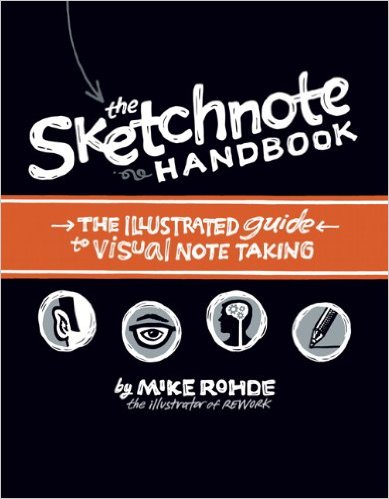
The other breakthrough came when I saw The Sketchnote Handbook by Mike Rohde in my local library:

The most important thing I picked up from the book is to use pen instead of pencil. This forces me to always make progress instead of erasing and re-drawing and second-guessing myself. It also makes me more forgiving of my mistakes, and come up with creative ways to fix them.

In the toolbox about bullet lists, I made two bullets with stars, because a single bullet doesn't make a list. And then I realized that I have nothing to more to say. What to do? The second star was already drawn. With ink.

I ended up writing "There is no second point" next to the second star. And you know what? It now emphasizes the fact that it doesn't take much to make sketchnotes.

A lot of serendipity came from using a pen and being forced to make things work.

Find your style

I really enjoyed the The Sketchnote Handbook because it includes examples from many sketchnoters. I pick and choose techniques that works for me:

  • Some sketchnotes are very free form, popping images left and right seemingly randomly. That terrifies me. But many examples use a grid style. I came up with my own layout algorithm: top to bottom, and if an item took too little horizontal space, put something next to it. This is very similar to traditional note taking, just using a bit more horizontal space. I can do that.
  • Some sketchnotes fill the whole page, and the pressure to do so paralyzes me. But many examples have whitespace between the items, and that is totally okay.
  • The book recommended using a vertical layout for panels, drawing the face of one panelist on each column. There is no way I can draw portraits. So I skipped that part. But it also showed a few simple ways to draw people. Now Starfish Man is a regular cast member in my sketchnotes.

Share

This is the most potent motivator: Twitter. You know how some people take a screenshot of a block of text to get around the 140 character limit? That looks stupid. But I can totally post a sketchnote to stuff more content into a tweet. And it looks awesome. So awesome that I get lots and lots of retweets, which gave me the confidence to do more sketchnotes, which gets more retweets.


Gotta love that positive feedback loop!

Thursday, March 8, 2012

Sketchnotes class

I always admire people who can draw. When I met Alexis Finch at Women 2.0 PITCH conference, I told her that I adore her sketchnotes, and wished I could draw too. She said, "come to my sketchnotes class!" That's what I did tonight.

Our first exercise was to think back to our elementary school days, and re-created the doodles we drew on our notebooks. That was easy - I loved twisting ribbons around a pole. And block letters.

That was a great warmup because it reminded me that, hey, I doodle too!

Next Alexis shared some tips and trick to draw fast. She asked us to practice faces.

And then we tried adding bodies and limbs to draw people, picked our special animal, and tried various shapes and objects.

We had a quick lecture on the different styles on sketchnoting, and what it is good for. Then it's time to put everything to use. Alexis played us some podcasts and asked us to take notes. We did two. The first one I was so overwhelmed that I did not really have any bandwidth to understand the speakers until half way into the podcast, which meant my pictures did not really carry any meaning. The second one I made sure I jot down words that made sense, and only fill in the graphics when I felt comfortable with the pace.

The podcast was about the periodic table. It was actually pretty cool.

I was especially excited when I heard that Dmitri Mendeleev left some gaps in the periodic table because he knew some elements were missing. I knew how to draw tables, and I knew how to represent gaps!

That was when I had my epiphany. My repertoire of shapes and objects is quite small right now, but when I know how to represent something as a picture, I can actually draw it fairly quickly. I decided that I will continue to take notes by writing, but look for opportunities to illustrate. I may start with 90% words 10% pictures, and pick up more ways to depict ideas and expressions as I practice more.

I'm very happy that I came out of the class with a game plan to get more comfortable with drawing and doodling. Thank you so much, Alexis!