As a meetup organizer, I strive to be as inclusive as possible, but I struggle with picking a time that works for parents. I've surveyed the members to see if moving from a weeknight to weekday lunch time or weekend would work better, but there was no obvious time that works for everyone.
I was lamenting about this problem to Effie and she told me about Parents Night Out. Various companies and non-profits host evening activities where parents can drop off the kids and have some time to themselves. What about running a meetup on an evening when Parents Night Out is available?
I loved the idea, but I don't know the options available in the Boulder area. I mentioned that during a meetup and Sepideh said she knows some. I looked into the places she mentioned and March 15 was a good date at Shredder Ski, so I scheduled our annual Women Techmakers Lightning Talks that night.
I managed to get some event funding from Google to pay for the child care. I set up a Google Form for parents to sign up, and purchased gift certificates for them. This way, the parents did not need to worry about payment at all. Instead, I submit the receipts for the gift certificates and get reimbursed by Google.
I am so happy to find out about Parents Night Out! If you run a meetup, or know meetup organizers, please try this idea. Hope this will help make meetups more inclusive.
As some of you know, I'm one of the organizers for 360|AnDev. It's a lot of work to run a conference, so why do I do it?
I started the conference because I want an inclusive place for people to learn about Android:
We want it to be welcoming to beginners so that they can plug into the community right away. That's why we have a "Getting Started" track (see our CFP).
We want to encourage first-time speakers, so we run Q&A Hangouts to answer as many questions as we can.
We want people to speak regardless of their financial situation, which is why we cover the travel costs for speakers if their companies do not.
We did not collect attendee statistics last year, but you can see from our speaker lineup that we were off to a good start in terms of inclusivity.
We need your help
Last year we managed to break even, which was really good for a first-year conference that covers travel costs for speakers. We hope to keep it up, to have a financially viable event that we can run again and again. But we need your help:
Please spread the word. Tell everyone about the event:
July 13 - 14, 2017. Denver Colorado. 360andev.com.
If you plan to attend, please buy a ticket right away so us organizers are not sitting at the edge our seats wondering if anyone would come.
If you are at a company, please ask your employer if they would like to sponsor the conference: 360andev.com/sponsorship.
I had the honor to deliver the Day 2 keynote at Droidcon Boston.
I prepared
extensively when I first gave this keynote at Android Summit, so this time I was
relatively chill about it. I updated some of the slides, and gave a practice
version at Denver Droids.
For a last minute refresher, I brought the video recording on my laptop and watched myself give the talk
on my flight to Boston.
Fresh material
Normally I do not tweak my talk the day before the conference, but after seeing
the shout-outs in Annyce's opening keynote I was inspired to do the same.
My talk is about how sharing makes you an expert, and I used tweets from day 1
of the conference as examples.
Learn from each other
That is the beauty of going to a conference: we learn, we share what we learn,
and we lift each other up. It was really rewarding to see people getting out of
their comfort zone to tweet, blog, sketchnote, and plot to give their very first
talk. This is how we build a community.
I was speaking at DroidKaigi in Japan in February, and would not have too much bandwidth to organize the talks. Fortunately Amber Grimaldi kindly agreed to host the event. Just like I outlined in the report from last year, she reached out to individuals asking them to speak, followed up to make sure they prepared the slides on time, and of course, emceed on the night.
Twitter
We used 2 hashtags: #WTMBoulder to get a quick summary of our event, and #WTM16 to share the evening with the rest of the Women Techmakers community.
I was the camerawoman for the night. I followed my own instructions for recording talks: screen capture for slides, camcorder for face of the speakers, use audio to sync them up. There was a bit of post-processing to decide where to overlay the camcorder feed to avoid blocking the slide content, but otherwise the editing was pretty straight-forward.
A few of the speakers never gave a talk before, and would like to get started. A lightning talk is a great way to get your feet wet, and I was very happy to be able to record them. Now they have a sample online to apply to speak at other events!
Google ran its first Android Dev Summit this November, and I gotta say, it was amazing.
Session Videos
The AV team edited and posted the videos within 2 hours of the talk, so everyone can enjoy the content. My absolute favorite was "Android Studio for Experts". So many tips and tricks!
I will scan them and add the high-resolution version to this PDF when I get home: gum.co/Sketchnotes2015. Download the current edition to get an email when it is updated.
Encore!
Android Dev Summit gave us Android developer lots of in-depth technical content and easy access to the team. I hope Google will do it again!
Just got back from Big Android BBQ, and it has been super fun!
Korean mall
I arrived the day before the conference to hang out with Virginia Poltrack, my partner on Fit Cat. I needed a pencil case for my Copic markers so we went to the Korean mall in Carrollton.
First stop was H-Mart, where we ate some yummy
dumplings and bought Asian fruits and snacks. And then we went to Daiso, my favorite Japanese dollar store.
To be honest, when I first looked into this conference I was worried that it is more of a party than a technical conference. I decided to go any way, betting on Google Developers to provide a healthy dose of Android on top of the BBQ.
Colt McAnlis opened the conference with a hilarious Texan keynote.
I gave my Advanced Android Espresso talk towards the end of the last day. It was my second time giving this talk, so I was pretty relaxed about it. But the projector stopped working in the middle of my presentation! I stood on stage not sure what to do, and literally said, "Help!"
The AV technician came to debug, at which point all the plugging and unplugging crashed my laptop. So I asked to borrow a computer from the audience. After a while the projector was finally working, and what did I do? Accidentally close the browser on my loaner laptop, which had the slides preloaded. The conference wifi wasn't connecting, so a friend set up his Android phone as a wifi hotspot.
With all that, I finally resumed my presentation. I think I stayed quite calm during the whole fiasco, but it totally disrupted the flow of my talk. I was very pleased that the talk was recorded though, and the AV team at Google did an
amazing job with the editing. I had to watch it 3 times to find the cut point!
I really enjoyed Big Android BBQ. Everyone is so friendly, and there were many fun little details. The sessions vary in technical depth, but caught quite a few good ones. All in all a great event!
My Android Summit keynote refers to many of my blog posts, and I want to provide links for people to read more. I could stuff all the links in the slide deck, but I decided to try something fun: Live tweet my own talk.
Timing
I used Quicktime to record my talk rehearsal, and watch the video with a pencil and note pad to jot down the minute marks that I am on a topic with a relevant blog post.
Buffer
With the timings, I schedule the tweets to using Buffer so they go live as I speak.
Final touch for my #AndroidSummit2015 keynote: Scheduling tweets to be posted as I speak. Next: Pack! 💼
I put my twitter handle on every slide, and tell people to follow me so they can get the relevant links as I speak. People were really surprised to get notifications for my tweets while I was clearly still on stage busy speaking!
Sharing brings you expertise. Don't believe me? Explain ListView to a friend. You will know it way better afterwards. #AndroidSummit2015
I was really excited about Droidcon NYC, not only to learn the latest in Android development, but also to hang out with my fellow female developers. With 22% women speakers, it was not difficult to bump into them during the conference. And I loved it.
Android Dialogs
Huyen and I flew in a day early to record for Android Dialogs, and we got a lot of footage to edit. Here is a recap video to thank everyone who helped us, especially Yash who booked a conference room at her office for us.
Espresso
My talk, Advanced Android Espresso, was assigned to a smaller room upstairs. I have to admit I was disappointed when I saw that. However, everything changed when I was actually in the room. It was packed, and people were staying at the back. The energy was way better than the main stage, which can hold all the attendee so by definition will be rather empty during the 4-track sessions. I much prefer to have a full house!
Droidcon NYC talks are 40 minutes each, and I had so much to share on Espresso that I took them all up. At the end of my talk, I said, “I won’t be taking live questions. Please come up to chat off stage.” Afterwards, my friends told me that they were quite impressed that I dared to defy the norm of taking questions after a talk. Hey, it’s my stage, and I get to call the shots :)
Diversity panel
Besides the Espresso talk, I was invited to be on the diversity panel at Droidcon NYC. We got an audience question on how to cope with a misogynist boss. A female panelist replied that sometimes the best thing to do is to walk away, only to be contradicted by a male panelist, who suggested talking to HR.
“Go to HR? That will destroy your career!”, I thought to myself. “Why would he say that? Are we now touting the party line?” I was so shocked that I did not know what to do. Fortunately, Corey jumped on stage and said what I wanted to say: HR is there to protect the company, not the employee.
We had a discussion off stage after the panel, and to my surprise, the men actually did not know the horror stories of women going to HR only to face retaliation! It was so widely circulated in my circle that I assumed everybody knows.
This panel was truly an eye opener.
Sketchnotes
I started sketchnoting in March, and it was been amazing to see the community pick up on it. There were so many of us sketch noting at Droidcon NYC, including a professional who recorded the keynote by Corey Latislaw.
One of the speakers had an emergency and could not make it to the conference. The other speakers want him to be there in spirit, so they inserted a meme slide to their deck!
Just got back from Google I/O, and as always, there was so much happening that I constantly felt that I was missing something awesome. This year the lines were particularly bad though. Not only there were long lines for the keynote, but most of the sessions filled up very very quickly, big or small.
Small sandbox for Espresso? 4 walls of people all around. The sandbox talks were run twice, so for the second run I sat through the previous talk just to make sure I had a seat. It was ridiculous.
I stood in line 20 minutes early to make sure I get into What's new in Android Developer Tools. I was taking notes furiously, but there was no way I could keep up with Tor demoing at machine gun speed. Gotta download Android Studio 1.3, pause the video as each new feature is mentioned, and try it out:
I just made an Android Wear watch face, Fit Cat, that integrates with Google Fit so the cat gets fitter as you walk more. I had some trouble with the Google API Client, and it was super useful to talk to the engineers on the team.
I have been writing many blog posts on Espresso, and really wanted to meet the team. To make sure I did not repeat my mistake of not getting a space at the first run of the sandbox talk, I got to the second run super early. Like, a session early. Result? Front row seat (actually, bean bag), and a great conversation with Valera. Yay!
I want more!
I really enjoyed the sessions I went to, but I missed so many. I would love to see Colt live, but alas, so did many others, and I didn't manage to even get close to the sandbox.
The open playground area was really fun, but I am ready to sacrifice it if that translates into more room for talks and thus, more chance to see our awesome Google presenters in real life.
The third day of Write/Speak/Code is dedicated to contributing to open source.
Speaker buddies offsite
I have known my fellow writing panelist Corey Latislaw for a while, and we have always been speaking buddies, pushing and supporting each other. Rather than attending code day, we decided to have an offsite to catch up.
Yes, we played hooky for a leisurely brunch at Feast and a lovely walk on High Line. And we talked about our next steps as public speakers, brainstormed talk ideas, and plotted the steps to make it happen. This is the hallway track taken to the next level :)
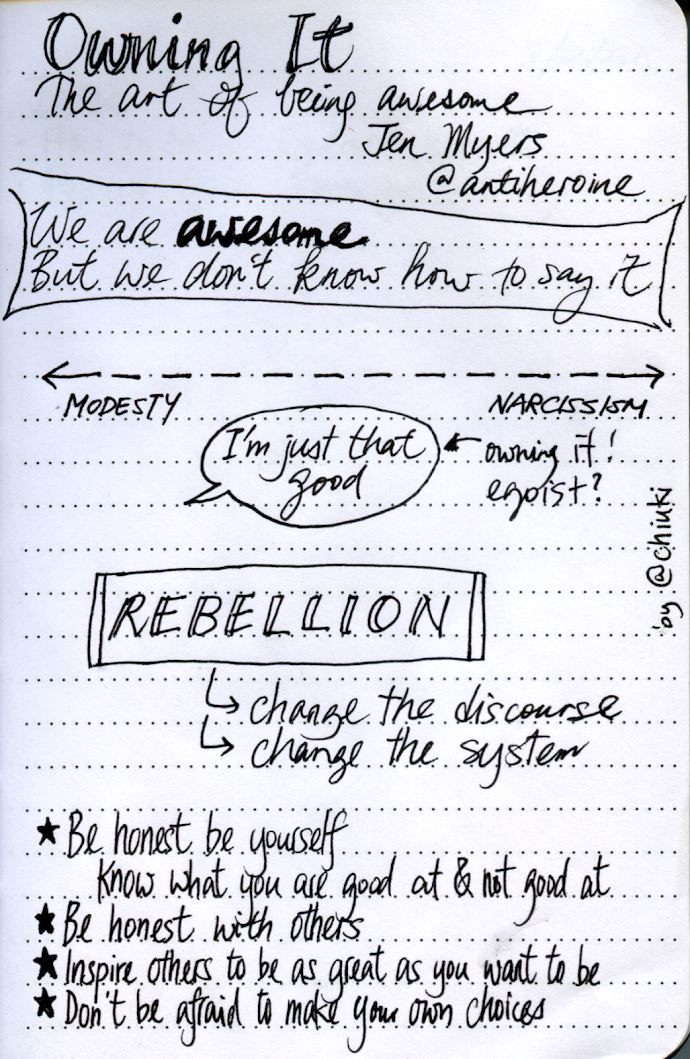
The art of being awesome
We headed back to the conference just in time for Jen Myers's talk.
The awesome machine
"Awesomeness begets more awesomeness"- this perfectly sums up #WSC2015conf. Big congrats to the team! Looking forward to what comes next :D
Write/Speak/Code is a great combination of practical advice and dedicated time to write, to speak, and to contribute to open source. It is also a congregation of amazingly awesome women, pushing and supporting each other. Everybody is super charged with energy, ready to take their endeavors to the next level. Or as Buzz Lightyear puts it, to infinity and beyond!
This is a part of the Write/Speak/Code series. Read more:
Intro,
Write,
Speak.
The second day of Write/Speak/Code is dedicated to speaking: writing a talk proposal, and giving a lightning talk.
Work in pairs
We started the day with a few exercise to brainstorm talk ideas and find a partner with similar interests. Each pair worked together throughout the day to write the talk proposal and prepare the lightning talk. Thisbuddy system is a brilliant idea, not only to bound off ideas during the day but also to hold each other accountable after the conference ended. I hope everyone will keep in touch with her partner and push each other to propose to conferences, help each other refine the talks, and cheer for each other as we all step on the stage!
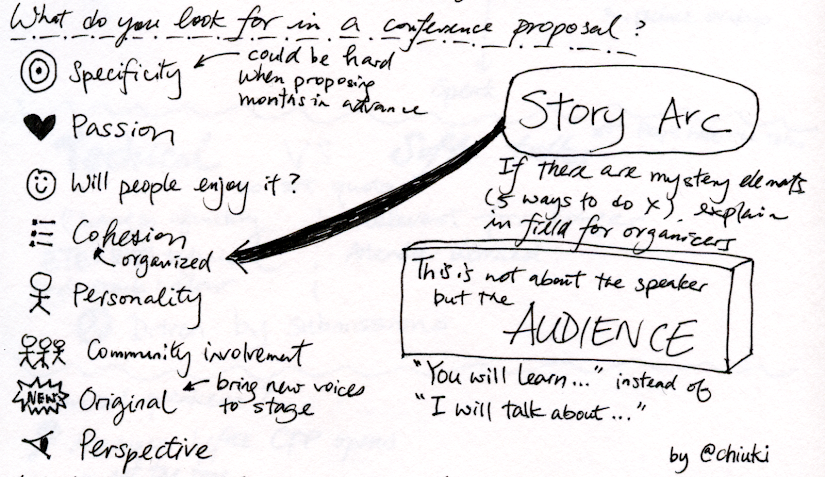
To help us write better proposals, Write/Speak/Code put together a panel of conference organizers, sharing their experience on the other side of the table.
After the panel, we split into small groups, and speaker mentors gave feedback to the talk proposals written earlier.
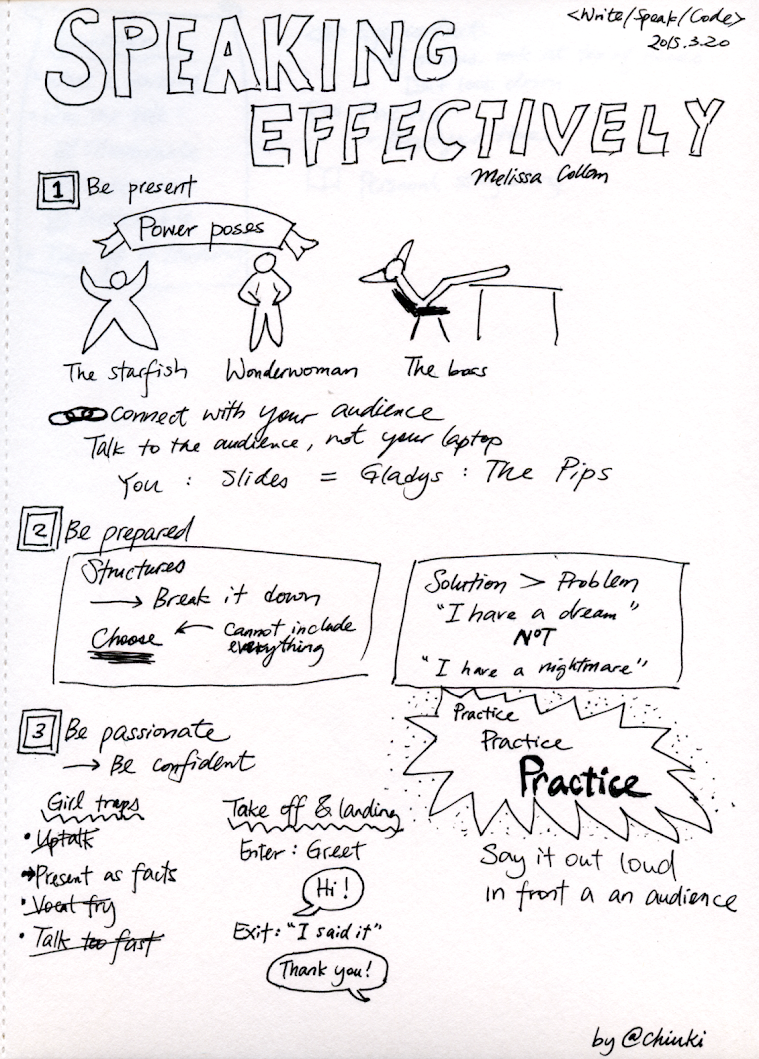
Speaking Effectively About Your Work
Next lecture is from Melissa Collom on how to create engaging presentations.
Lightning talks
Just like Write day ended with writing, Speak day ended speaking: give a lightning talk! Each talk was recorded, so everyone received feedback on the spot and can also go back to watch and review their talk.
This is a part of the Write/Speak/Code series. Read more:
Intro,
Write,
Code.
I really like how Write/Speak/Code alternates between hands-on activities and lectures/panel. Next up is the writing panel, and I got to share my experience alongside Pam Selle, Debra Williams-Cauley, Julie Steele, and Corey Latislaw.
We concluded Write day by writing a blog post. I just stepped off the writing panel, and realized that I forget to share my blogging formulas, so I ended up writing a blog post on how I write conference reports. Oh so very meta!
This is a part of the Write/Speak/Code series. Read more:
Intro,
Speak,
Code.
When I heard about Write/Speak/Code, I know I want to be a part of it. My career has benefited tremendously from writing blog posts, speaking at conferences and sharing my code as open source, and I want to empower other women developers to do the same.
Make it happen
Once I decided that I want to help out at Write/Speak/Code, I need to figure out how to make it happen. I met Vanessa Hurst while we were both speaking at OSCON 2013, and she co-founded Write/Speak/Code, so I reached out to her. She put me in touch with the organizing committee, and while I was waiting for results from mentor nomination and selection, I decided to write a blog post in the spirit Write/Speak/Code and send that to the organizing committee. A few weeks later, they invited me to be on the writing panel and also be a speaker mentor. Yay!
I normally don't share stories like this, but I feel this is appropriate for Write/Speak/Code. If you want to speak at a conference, there are many ways to get in the door. Answering to an open CFP (Call For Proposals) is one way, but you can also reach out to the organizers directly. If you don't know them, get an introduction. Make it happen.
Write/Speak/Code
Write/Speak/Code is a 3-day conference, each day dedicated to Write, Speak and Code:
To celebrate International Women's Day, Google Developer Groups all over the world are hosting Women Techmakers events. I organize the local chapter, GDG Boulder, and I thought this is a great opportunity to showcase the wonderful women techmakers in our community. Inspired by the popularity of Ignite Boulder, I decided to host a night of lightning talks.
Since I was new to the Boulder area, I don't know too many people. As a result I pretty much asked every single female developers I know if they would like to give a lightning talk. Some of them are from GDG Boulder, others are DevChix members I met over lunch. To my surprise, almost everyone said yes. I was expecting resistance because usually when I broadcast speaker request over mailing list, nobody replies. I have two theories:
Boulder people care about the community, ready to step up and contribute when asked.
Asynchronous broadcast aka email blast is a bad way of asking. Synchronous 1-to-1 is the trick.
When I asked someone in person or over instant messaging, they have to tell me yes or no on the spot. My suspicion is that it is difficult to say no, so I ended up getting quite a lot more yeses than I expected. On the other hand there is no cost to say no in an email broadcast. You just do nothing.
Spread the word
After I found speakers, picked a date and secured the venue, it was time to spread the word. I added the event to our Meetup page, and posted on social media as well. But what brought most of the attendees was cross posting to other local groups. Rylee Keys was especially helpful, inviting members of Women Who Code and Girl Geek Dinner to join us at the lightning talks.
Talk preparation
A few of my speakers said they have nothing to say, which such is a normal response when people get asked to give a talk that I actually gave a talk about it. I offered brainstorming help, and helped half of the speakers come up with their topics. I was ready to give feedback on the slides as well, but they procrastinated so much that there was no time to do it.
Master deck
I know everybody is busy, so I set out deadlines for the title and slides for the talks in advance, hoping that it would help some of them set aside time to prepare. And some of them did. But I needed to nag the rest during the last week, and it was quite stressful. Normally speakers can work on their slides until the last minute if they present from their own computers, but since each talk was only 5 minutes long, swapping machines constantly would be very disruptive. To avoid that I took cue from Ignite Boulder to have a master deck that combines decks from all the speakers. This means I needed the slides ahead of time, hence the nagging. I got the last deck an hour and a half before the event, and breathed a sigh of relief.
Clicker run-through
I have spoken at Ignite twice, both hosted by Brady Forrest. He runs a really smooth show, and one trick is to sit the speakers in the front row, in order of presentation. I totally stole that.
Unlike Ignite, I am not advancing slides automatically, so I brought a clicker for the speakers. I had the speakers come before the door opened to the public, lined them up in order of presentation in front of their seats, and did a clicker run-through. I started clicking through the intro slides, passed the clicker to the first speaker, had her review her slides while trying out the clicker, and passed it to the next speaker.
Show time
Door opened at 7pm, and slowly the room filled up. We had more than 100 attendees, which was really exciting. Here is the slide I projected when people were mingling before the event started:
See the hashtag? I wanted people to talk about the event on social media, and they took the cue:
I kicked off the event at 7:30pm, explained GDG Boulder and Women Techmakers, and turned the stage over to the first speaker. One after another, our speakers regaled us with fun and inspiring stories, ranging from freelancing to hackathons to refactoring to wearables.
Time flies when you're having a good time, and before we knew it the talks were over. I went back on stage and asked if everyone enjoyed the show. After an enthusiastic yes, I encouraged people to get in touch to give a talk as well, so we can have more events like this. A few people took up on my offer, and I am super excited to hear their stories!
Lightning talks is a great way to celebrate your community. Step up and make it happen! Here are some lessons I learned:
Invite speakers individually
Ask local groups to spread the word
Project the offical hashtag before the event starts to encourage social media engagement
Prepare a master deck for smooth speaker transitions
Sit the speakers in the front row, in order of presentation
Keep it going by encouraging attendees to speak. Add a question to your RSVP to ask if they want to give a talk. Make an announcement at the end of the event.
P.S. In the spirit of asking, the GDG Boulder Youtube channel needs 500 subscribers to get a custom URL. Will you be so kind to subscribe?
But to be honest, when Kelly invited me to be on the panel, I wasn't sure what I got myself into.
You see, I have seen many bad panels. The panelists showed up without any preparations, so instead of an insightful discussion, it was just a bunch of people spewing unorganized thoughts on stage.
Fortunately the panel last night was not like that. Far from it. The panel was very well put together, educational and entertaining all at once.
So, what makes a good panel? Contrary to popular belief, it's the moderator, not the panelists. True, the panelists are the ones talking most of the time, but the preparation before the event makes all the difference, and the moderator is in charge of that.
Kelly was a fantastic moderator. Here is what she did:
Invite panelists with various backgrounds
Send questions to the panelists ahead of time
Highlight the unique experience of a panelist by asking a question specific to one person
Contrast the different perspectives of all the panelists by having all the panelist answer the same question
There were 5 of us on the panel. Some are hackathon participants, others are judges. Some are developers, others are subject matter experts. We all received questions a week before the event, and were invited to add more. I was asked to define the different types of hackathons since I did that in my Ignite talk on hackathons at Google I/O, but everyone got to answer questions like "Why do you attend hackathons?"
A good moderator curates the content by assembling panelists with complementary skills, let them know what will be discussed ahead of time, and directs the flow of the conversation. The hackathon panel hits all these points, and it was a real pleasure to share my experience and learn from the other panelists at the same time.
Android Hack Night is for everyone who's interested in Android programming. If you...
Have no Android experience
Install Android Studio on your laptop and we'll walk through Hello World together.
Just got started but not sure what to do next
Follow the Udacity course and bring your questions.
Tinker with Android as your side project
Bring your project, share what's working and where the pain points are.
Live and breathe Android
Come help others, or, if you are brave, there will be a coding challenge where you write an app on the spot and present your solution.
We will all be coding, so don't forget your laptops, chargers, Android devices and USB cables!
We had a pretty good turnout, almost 30 people. I asked everybody to introduce themselves and tell us about their Android experience. Since there were quite a few beginners, I gathered everyone who'd like to step through Hello World in a corner, and the rest of the people huddled in groups to work on their apps.
Couldn't get the projector to work so I held up my laptop.
Initially I was going to have every group share what they did at the end, but I lost track of time while helping people with their emulators and devices, so it was a bit of a bummer. But overall it was really fun, and I definitely want to do it again!
I can't believe this is my fifth AnDevCon already! This time I am living in Colorado, so Burlingame is no longer local. But as luck would have it the GDE Summit is one the same week at the Google headquarters, and I got to combine the two trips. The flip side is that they overlap quite a bit, and I ended up only attending the last two days of AnDevCon, plus the fireside chat Wednesday evening.
Fireside chats
There were two fireside chats / panel discussions at this AnDevCon, both very informative and entertaining:
I didn't go to many sessions, partly because I was only there for two days, but partly because each session is 75 minutes long. After subtracting time for keynotes and sponsor sessions, there was really only time for 3 to 4 sessions a day. Since I was giving two sessions myself, I ended up only going to 5 sessions.
I gave the 40-minute talk at Øredev, but the audience reaction was quite different. Here I was among Android developers, and people jumped in with interesting questions pretty much right away. I loved that! I was having a great good discussion off stage afterwards as well, but had to cut it short since I needed to run to another room to give another talk.
RxJava is quite hot among in Android world, and I am very curious about it. I attended a talk at Droidcon London but didn't quite get what it is, so I tried again with a session at AnDevCon. Alas:
2nd time a RxJava talk shower me with marble charts from the get go. I wish they explain the basic async sequence logic first. #AnDevCon
This time I got a bit further: I understood that RxJava builds on the concept of asynchronous sequences, and as a result you can apply many operations on them. That's why there were all these marble diagrams for map, filter etc. I think I should give up on trying to learn it by listening to a talk though, and instead get my hands dirty with tutorials:
When Cate and I was touring Copenhagen, we talked about how we got into public speaking. One thing led to another, and we decided to publish a newsletter together. We had a little bit of time on Monday before Øredev, so we put together our first issue in the hotel lobby!
Sauna, bus tour, glögg and the city hall
After we prepared our newsletter we met the organizers and other speakers to head to Kallbadhuset, a Swedish bath house perched on top of the Baltic Sea. We had an appetizer (herring!), went into the sauna (hot!), dipped in the Baltic Sea (cold!), and then had dinner (more fish!). My first night in Sweden, and it was definitely super Swedish.
And that was just the start of the speaker activities. Tuesday they organized three things for us, starting with a bus tour of the city of Malmö. I signed up for the 3pm tour so I had the morning free, and grabbed Cate to see the astronomical clock in Lund.
Later in the evening, we had a pre-dinner event with glögg (glüewine) and pepparkaka (ginger bread cookies), and an acapella performance!
Then we moved to the City Hall, where we were addressed by the mayor of Malmö, and dined in this beautiful hall.
The conference
The conference started on Wednesday, with three days, eight tracks, more than 150 sessions total. With so many simultaneous talks, I had to make a choice every hour, and I came up with a strategy. I prioritize talks with:
Great speakers
Props
Technology that I would not look into otherwise
Great speakers
James Mickens definitely falls under the "great speakers" category. His talk was hilarious!
To top it off, Øredev invited Nile Rodgers for a candid chat!
A superbly run conference
Øredev is the best run conference I have ever been to. The attention to detail is amazing.
A round badge! With a lens in it!
The podium seen through the Øredev lens.
Sign posts pointing to the rooms. Much easier to see than signs on walls, which they also had.
A smoke screen!
Lightweight feedback screen at the door of each room.
Other impressive things:
There were at least 20 minutes between the sessions, so even if one session ran overtime it wouldn't eat up time from the next session. Also gave you time to hang out in the hallway and talk to people, grab a coffee etc.
Speaking of coffee, there were plenty of food: breakfast, lunch, snacks, and dinner!
And they treat their speakers really well. All travel costs are covered, and they pampered us with so many speaker activities.
Finally, all sessions are recorded, and uploaded right away. They were so efficient, I don't even know how they did that.